Monday, September 5, 2011

Nature Morte with Mixed Messages?

pl

III. Still Life Images with Obvious Associations
If you look in the Album assembled to support these essays, you will see in the sequence nos. 52–64, images that are the least unsuccessful (i.e., not moved) recording the accumulation of souvenirs little changed in the four years since the grayscale images of nos. 1–2 at the beginning of the Album, when the Christmas card with a Fra Angelico angel was recently received.
The mantelpiece which faces north is not well lit, but it had inspired this Game of Nature Morte, so finally I put the tiny camera on a big tripod and struggled to get it both near enough and high enough, tilted up, to get what I wanted to see: the semi-circles of the basket and half of the angel's halo as my principal motifs.  I barely got all of the Scribe's head, and I cropped excess off the bottom and managed to include the angel's profile.  The pin from the Egyptian exhibit at New Orleans raised its wings, and a king-cake baby that had escaped the transfer of the rest of them to the kitchen window sill raised its hands (from so close and at this angle).  A student who had been to Delphi brought me the sphinx, and another brought me the Discus Thrower fixed to be a Christmas tree ornament by the addition of an eyelet screwed into its head.  But they don't belong to this image.
In other words, to avoid breaking my own rules (beyond removing the hurricane candle left over from Gustave), I struggled mightily to get from it the formal organization of the above image.  Since this is in a dark-pink room, with black mini-blinds and sofas (and a red and gold painting off camera to the right), the receipt of that fine card with the Fra Angelico angel, over half a decade, was determinative to the requisite accumulation.
It must be understood that, whereas families stereotypically put lots of framed photos and snapshots of their own all over their living and working spaces, a number of us, usually single, make accumulations like this one, adding as whim governs.  For example, I put the Lenten New Orleans baby in the Scribe's lap because of the Dynasty XVIII statues of Senmut holding the infant princess Nefrure (the only Egyptian statues where Scribes hold babies); besides, that plastic baby is so pink.
But, of all the mantelpiece photos that I took with the new Nikon S9100, only this one has the purely visual compositional and coloristic integrity to qualify as a true Nature Morte.  Any importance it has is formal, viz, abstracted from the mundane stuff that the camera was made to register.
VISION creates the image, and lenses and focal planes and apertures are the brushes, pencils, etc., the graphic tools that vision has to work with, since PHOS, light, is what they all, severally, record.  That is why, with new kinds of cameras today, I made a photographic game precluding processes that Strand used.
Anyone can see that my mantelpiece stuff is just souvenirs (though the originals weren't).
Now let's consider my favorite image with mixed messages.
bw
First, the British Museum terracotta plaque card (which when shifted changes from monochrome to color, based on such works as the Mari frescoes and probably correct) is always called "Lilith", because of the fearsome 'screech-owl' in the King James translation.  I have discussed her elsewhere:  http://www.forumancientcoins.com/ayiyoryitika/ProlegomenaEros/ProlegomenaEros.html, under Figure A.  Behind her is a box of science fiction dvd's (but also at far left a Rigoletto which I take for the delightful one directed by Jean-Pierre Ponnelle).  Similarly, the classic film of Orphée by Jean Cocteau suggests no more than that the shelf photographed here belongs to someone whose idea of an old movie is not one from the early 1990s.  But the statuette of the woman (it would be about 20" tall if it stood) is, in my opinion, powerful and not like a goddess or even a royal ancestress, nor yet, despite her slender nudity, an adolescent girl just through a rite of passage (I have tried to imagine everything I can), as her crossed arms with large, expressive hands (and also bashfully or anxiously crossed feet, visible in another photo several years ago) might suggest.  Her face resembles one on a Shang Dynasty square ding, but also that of the Turkana boy, a homo erectus who died young, as reconstituted by the skillful Victor Deak.  At that time she already sat in this bookcase, though apparently on the next shelf up, since the wooden seat that she came with was impermanent, degradable.  It is a most likable statuette, and it sits where its owner can look at it, but its associations (unless with the "Lilith", temperamentally quite unlike) are accidental.
Now, I insist this is a true Nature Morte, though it defies being looked at like some Pipe or Apple or Bottle.  It is in strict perpendiculars, with significant coincidences, at several scales and like receding planes; depth is given by darkness, too, though the red and blue at left pop out; the pale reflections in the lucite case of the Orphée respond to the similar tints of the woman's headdress.  The image, even the iconic seeming statuette itself, would not be so powerful if otherwise seen and framed.  In this respect it is like my mantelpiece still life.  The bw image is (take your choice) either a work of art parallel to but independent of the statuette, or the statuette is above all a constiuent part of his photographic image.  Neither would be the same without the other.
bw
It is so much the easier therefore to enjoy looking at the sci-fi still life as such.  The style of lettering and the titles will give real pleasure to all who have loved them, and the containers formed from slabs of china clay (I think) with the similarly fabricated YES in one of them, do show that this shelf belongs to them, whether or not I am right in reading our moon on the one at left.  I don't even know whether they are explicitly meaningful, but like Galactica's letter forms they have formal meaning—and I may be right in reading the IS in a circle as corresponding to that moon.  No matter, chiastic warm and cool colors make this a delightful still life.
bw
The line dividing a photograph for a museum catalogue, scrupulously recording the profiles of these Late Classical cups, a skyphos and a kylix, one in the Gnathia style and the other plain black glaze-paint (the most waterproof and durable), and a Still Life, is very fine indeed.  An art museum might be especially concerned with the aesthetics and to show the three-dimensional objects in real, directional light (not too strong, of course) to give them a sense of atmosphere and space.   I think these are privately owned,  but the style of photography would do equally well for the V&A.
ac
When I saw this image about a centimeter wide as a 'thumbnail' on a friend's cell-phone screen I asked to have it for this blog post.  When it came, the EXIF had hardly any metadata, so I asked whether it really was taken with a phone camera or perhaps with a film camera.  In fact, it was taken with a cell phone.  It proves that this Game could be played with cell phones alone, if it had to be.  She saw the light, she aligned the chopsticks, she got the essential combination of diagonal and foreshortened circle full of round toppings on the ramen; the camera was capable of recording the weave of the cloth and the stoneware glaze of the bowl.  Of course, it won't enlarge so far as some of the others (but neither will most photos taken on film).  The yellows and reds in and out of the bowl echo each other.
But would this photo also serve a cook book, just as the black-glazed cups also would serve a museum catalogue?  Of course.  But a lot of museum and culinary images lack their artistic properties.

I intend to write one more blog post in this series, considering some images alone, rather than as representatives of categories.


Sunday, August 21, 2011

Nature Morte in response to the Modern

Denise (study all the triangles and parallelograms!)
II.  What began with Paul Strand
Paul Strand, in the course of a long career, worked in a number of kinds of photography, but we are concerned here with the body of work completed in his twenties, just before World War I, exhibited and published by Alfred Stiegltiz in Camera Work in 1916-1917.  Ideally, those who don't know this body of work should try to get access to Sarah Greehough's Aperture publication of the National Gallery's exhibition in 1990.  The Dover Press published in 1978 a pictorial index to all of Steiglitz's Camera Work, thus providing a conspectus of the introduction of the latest 'cutting-edge' European art to New York City at Stieglitz's Gallery from 1903 through 1917, including Cubism.  With international distribution (not to mention the American west coast) of Camera Work, Strand's experiment to discover and to show that straight, unretouched photography could explore vision as well as anybody's cubism immediately reached photographers worldwide—just before the War brought such efflorescence to a close.
The succession to this accomplishment of formal, abstract values in pure photography informs most of 20th-century gallery photography through at least six decades, since the curriculum of the Bauhaus (itself further disseminated by the diaspora of its faculty caused by World War II) also furthered the use of the camera as a means of understanding the meanings of form (see Laszlo Moholy-Nagy and the early work of Renger-Patszch, for example), and, since the Bauhaus was a school of Design, it still is usually dominant in high-end commercial work.  Basic design courses in art schools even today are rooted in this tradition.  These brief notes, of course, only lead to much else!
Of course, Strand's famous early prints, at first platinum prints, then gelatin silver, are large CONTACT prints, nearly 11" X 14".  What can the little digital cameras do?  More than one might think, though obviously they are not the same.  But we are interested in how things are seen.
What is the relationship of analytic cubism to the Nature Morte?  First, the latter uses the forms of things not anecdotally (not, for example, to glorify the guitar as a musical instrument or the bottle for its contents) but as such.  When young Picasso and Braque began making cubism, they used the genres that Cézanne had been working with (Picasso also, like Degas, was interested in the camera's effect on forms in light).  Still life (unless you include Netherlandish laden tables and all their Fur and Feathers, which replace idolatry with the worship of gastronomy and hunting) is simply painting as such.  So: just in case you wondered as I did in my youth why cubists were so fond of musical instruments and newspapers and bottles—and, a novelty, printed lettering for its own sake, too.
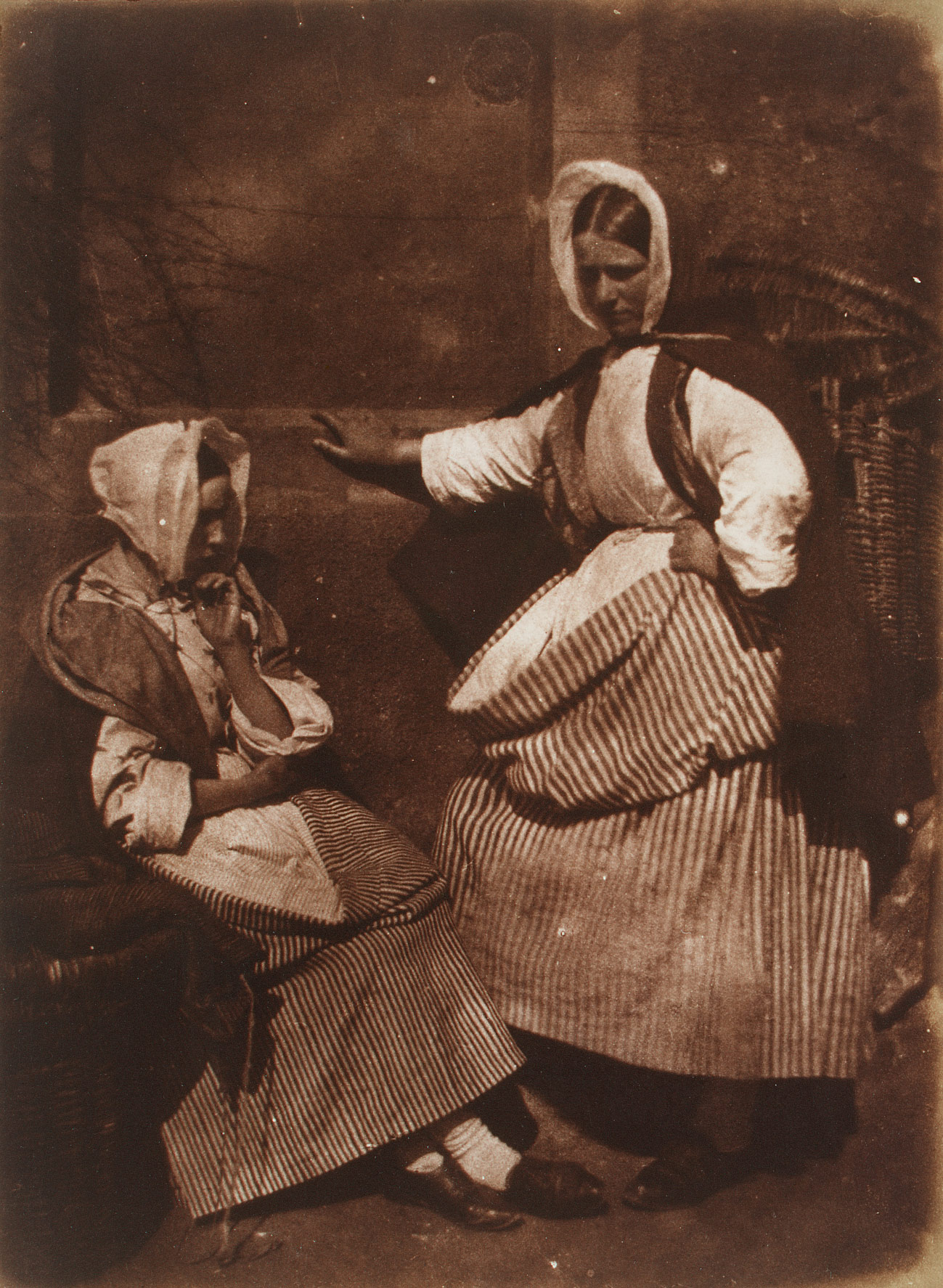
Now, the earliest photographs had to prefer whatever held still, but it was those who had an educated knowledge of art, Daguerre, because he was himself a painter, and Fox Talbot, because he belonged to a class of Englishmen who were educated in art and architecture, who made real still lifes in the first decade of photography.  Of course, these were carefully arranged and set up in advance, not "found" in one's ordinary surroundings.  You might say that they MADE a Nature Morte and then photographed it.  Most of the first generation, in any case, were interested in genre pictures, fishermen, card players; see the work of Hill and Adamson, though Fox Talbot also set up his friends as card players and in other pictures that were illustrations such as the public liked.
Again, it is with the last decades before World War I, not least with Paul Strand, that the Still Life Hiding in Plain Sight really took hold.  Among those participating in the Album that supports these posts, Denise is especially good in recapturing the discovery of Strand's work a century earlier, and both of them fully appreciate that it makes no difference whether the mundane identity of the things photographed is obvious or not.  In fact, the perfectly recognizable stuffed cats that I used in the last post are as perfect a formally, abstractly considered composition as can be: it's what the photograph IS, not what it was taken from.  That is why, too, when Denise's elderly and interested black cat came nosing in to help in what she appeared to be doing, his visible presence does not make him break the rule of the game, that cats "are not morte enough".  In this case, he is (though in everyday life, we are glad to report, he's perfectly alive), simply part of the photograph:
Denise
In this photograph, taken in the kitchen, the dramatic diagonal of a white board (materially, perhaps a nylon cutting board) is transformed by the pattern of reflections on it:
Denise
Their source is just discernible between the folds of the curtain, but the arc that they cast is the true subject of the image.
Similarly, it is not the chair and the barstool stand themselves but the dark design that they create against the complicated brightly lit material behind them that makes this image memorable:
Denise
Most dramatic of all Denise's contributions (also demonstrating positive exploitation of the small cameras' wide-angle extreme) is the image of a strong band of light in receding space, picking up in its course a sequence of objects, each different but not all of them identifiable in their daily-life character, and leaving inexplicit and perhaps unimportant the book-title legible at the bottom of the picture plane:
Denise
The term "picture plane" has been used deliberately, since, as in analytic cubism and much of Bauhaus teaching, the image discourages reading it as space in depth, in spite of the perspectival clues.

BW's casually diagonal vantage point to the righthand end of a book shelf is very discretely abstract, deriving its governing compositional coherence from the jagged shadows at upper right and the plain block of red at lower left:
BW
My own oddly modest, viz, unexciting, visual sensibility seems to tend to photographing light striking through cloth or paper, which is all I seem to do—not only missing the emulation of Paul Strand but also that of Imogen Cunningham, one of his earliest and most interesting disciples, but it is no good if one tries something phoney, so I don't:
pl
There is nothing 'modern' about it, but it is not a traditional Nature Morte either, and I do like (in daily life as well as in the photos) the color added by my accidental accumulation of king-cake babies and the bricks responding to the checkers.
pl
Even more unassuming is the composition that originated in a stack of half-folded laundry, but it is perfectly true to the least Modern of Strand's early portfolio, being not even a Nature Morte but a composition that is perfectly true to the picture plane, tied to it in fact by the apple-green garment among so many textures and kinds of stripes, greens and reds.
MS's cooking top works similarly, adding the reflections of ceiling fixtures in the polished granite.
ms


Tuesday, August 16, 2011

Traditional Nature Morte


I. The traditional Still Life, or Nature Morte

Since all the best images of famous examples are copyright, and this project began as exploration of the abilities of small, one-piece digital cameras, my friends have joined in this exploration and the entries may be seen in https://picasaweb.google.com/102498681030579488308/NATUREMORTE.
The initials or other chosen designation of each photographer is given here as in the Album.
We all found present-day equivalents true to the tradition without simply imitating the appearance of a Chardin, for example.
bw

Like a 17th-century Nature Morte, this new photographic one makes full use of composition in terms of light as well as shapes to create a unified Still Life.  The textures of pressed cardboard and paper towels draw attention to the the variety of smooth surfaces, and one metal lid refers to the metal foil.  The more you look, the more you notice the considerations that make it coherent and interesting.
ms: see her remarks in album
Perfectly true to Nature Morte, though also more interesting than oranges per se, here transparency and reflections work wonders.
pl: the best the small camera could do so far
Who would guess (I didn't) that a quartered orange could outdo the quartz?  The translucent rocks demand perfect focus throughout; when you zoom, you need more time and (handheld) may move, but with wide angle the compactness of the group is compromised:
pl: max wide angle
Like the whole mantelpiece, this is no longer really in the spirit of a still life.  Here I learned the limitations of using the Nikon S9100 according to my own rules!

Some of the purest Still Life is very simple, with only two or three objects (or even one):
bw
Some of us keep things that we like placed appropriately, but given a little light, noticed at the right time of day, things that are much less than objects of delectation can become Still Life in a photo.  As Robert Doisneau said of wet streets, they are better objects for photography than for painting:
pl
And a single crab, considered from a good vantage point, can become new, too:
anon
Denise, who is so good at seeing the abstract qualities in the ordinary, is also skilled in getting the most out of the chip and lens of a tiny Nikon S6000:
denise
The line between the simple Nature Morte and the use of a camera to abstract in the terms of early Modern art is hard to draw. 
For a beginning, enjoy these straight photographs of simple things, seen and framed in terms of the long tradition of the Nature Morte, to be enjoyed visually as such.  The more you look at them, the more you see.

Sunday, August 14, 2011

The Game of Nature Morte

The mantelpiece six years ago, when my friend Denise was visiting with her Nikon 8800.  An accumulation of souvenirs ready to become Nature Morte.  Taken deliberately in grayscale.
One year when there was a Biennale at Venice and a lot of special exhibits as well, I happened onto one of Giorgio Morandi, all paintings of vessels, still lifes of the greatest purity and deliberate simplicity imaginable.  Of course, like any art historian I was familiar with the genre of the Nature Morte (the French is truer to what it really is) even as pure and austere as in the post-Cubist Amadée Ozenfant or the Spaniard Zurbaran.  And I knew that even in the Hellenistic period, if not earlier, Greek artists had done smallish paintings of things, purely just for the painting of them (which implies that there were also connoisseurs of such work, free of anecdote or of symbolism).  In the heyday of the French Salon, the genre of Nature Morte was a category in its own right.  Chardin has, all his own, a gallery of still lifes in the Louvre.  The Impressionists, pre-eminently Manet, honored Nature Morte, delighting in which modern painters like Richard Diebenkorn followed their example.  The thing about such paintings, or photographs, is that there can be no reason for doing them at all but the artist's desire to do all that he can with his seeing the raw material and to get all that he can, as an artist, from it, at the same time offering the pleasure of such works to those whose participation in them is in viewing them and considering what the artist has done.  Cézanne's skull here is not a memento mori nor his apple for eating, nor some utilitarian object for using or the guitar for playing.  A Ming jade bowl and a toilet bowl (if by Edward Weston) alike are both just what the artist has done with them.  The proof of this is in such experiences as my afternoon with the work of Giorgio Morandi, who, I think, would not have used the form of a bathroom commode, lest anyone suppose it could be meant to refer to the article in daily use.  Once known, his work is unforgettable.
Through a half century of teaching art I have learned that, at least in America, young people have trouble understanding that works of art need not signify or suggest or teach that which verbal language does perfectly well.  Of course there are images, including some great ones, such as Michelangelo's of Creation in the Sistine Chapel, and some painful ones, such as Eugene Smith's, that leave much less license for kidding oneself than reportorial language usually does.  What I am saying is only that the genre of Nature Morte is full of meaning, but the meaning is gained only from looking at it meditatively (if I may use that word) and enjoying it visually.  I think that neuroscience is advancing in helping us to understand these distinctions, but on the internet one finds that almost everyone is regarding visual art as mere symbols or illustrations alone.  It is not that Still Life needs to work in terms of abstraction, though the young Paul Strand showed that photographs could succeed as abstract works without compromising the medium of photography, and there are plenty of abstracted photographs that are not Still Life.
Anyway, I was thinking, looking at my more advanced miniature camera with all its zoom and megapixels, how it would perform in a Game of Nature Morte, much more complicated than simply zooming at a construction crane on a bright day.  Already I have an entry that proves, once again, that vision rather than tools is the critical thing.
Though I wanted to participate, I didn't want to be limited to my own vision, so I invited a number of friends, who know what Nature Morte / Still Life is, to send me some of theirs.  I want to emphasize, as I multi-task (blog composition and PGA golf), that this is not a competition.  At least two of my chosen friends are better photographers than I am, but no matter: it is just to get varied vision that I have prevailed upon all.  I am eager to credit each one or to guarantee each contributor's anonymity.  Though it will be impossible to post every image in the blog, I shall post in a Public Picasa album all that I may and keep in a Private album any that the photographer prefers to keep private, though, N.B., indecency is certainly private and practically unknown in the genre of Still Life (though Fur and Feathers is important in Netherlandish Still Life, to avoid offending many animal lovers, I won't use them here, and bouquets of flowers similarly are hard to handle, since the criteria of specimen-perfection and the artist's vision can need more discussion than a simple game with miniature cameras can encompass).  I have no intention of judging anybody's photography, even my own, though a fundamental question is whether the intention was Nature Morte.
Contributions dribble in; friends may be shy or busy.  So I'll start with the simplest category.
I.  Photographs in the Tradition
II. Photographs to compete with Modernism
III. Photographs easy to interpret differently
IV. Photographs that are carefully arranged, either for commercial work or surreal intention; they may rely on the Nature Morte tradition without being part of it.

I sent my friends this list of criteria:
(1) Available light only
(2) Available arrangements only, relying only on vantage point and framing (to avoid those dreadful art school set ups that were so pointless and limiting
(3) Botany excluded as a subject (my pods on the stovepipes trees don't belong here, nor do the mushrooms)
(4) Cats as primary subject are not 'morte' enough
(5) Built-in lens only
Denise, who is VERY good at this kind of photography, may use the 8800 as well as the 6000, but the latter is actually faster, I think.  Older one-piece cameras also are OK.
The modus operandi I choose is to have the small camera at hand at all times (meaning I needed to get its own carrying case ASAP)
(6) No one needs to play but me, but in a couple of weeks I'll make a new blog post with a half dozen 1000 pixel images, just to show that shooting high and far is not the only test of a camera's utility.  But for anyone using a $100 camera, this is not a test of your lens or your chip.  I mean, the Nikon S6000s will do just as well as the S8000 and S9000 series and similarly all the same-priced competitors.

This potful of tools has been sitting here for at least a decade, and the light comes in every afternoon when it's not raining.  For posting but zooming, too, image should be 1000 pixels in the larger dimension.
I attached the first (fuzzy) version of this image to make clear that "Period" candlesticks and old wine bottles and wooden potato mashers are NOT of the essence.  As Denise said in an e-mail, "still lifes hiding in plain sight": not arrangements.


Friday, August 5, 2011

Glory to Technology

Building a new parking facility and bookstore at LSU
As our Health Science teacher said when we were in Junior High School (now called Middle School) it's no use to complain about the Facts of Life.  Similarly, in a week where the only slight comfort is reading about what they tried to do to Franklin Delano Roosevelt in 1937, I see no point in more talk about economics.  And I wonder whether they'll still be printing many books by the time that new facility (see caption) is finished (but it probably was approved and budgeted a decade ago).  Great building cranes have been in use, too, for a half century and though they're really impressive theirs is not the glory, though when I took a niece from eastern Washington state with me to Europe, she loved the cranes against lovely blue skies; that was in the 1980s when building was everywhere.  And the last time I could traipse all over cities, in 2002, my first, little digital camera boasted only 2X zoom: it could register a building crane, but just that, and I had no young niece with me to provide enthusiasm.
The Glorious Technology again is the combination of miniaturization and power.  A portable reel-to-reel tape recorder weighed as much as an L.C.Smith office typewriter.  During the Vietnam War families sent their voice recordings on cassettes.  But then came the Walkman, the first machine to record using AA batteries.  Today, for all the horrors of improvised explosive devices and clouds of hot dust and all, finally (for the moment) soldiers in current wars do not lack for IT: it is even possible to watch the birth of one's baby in real time (if only you can live to raise the child), and you watch it on a device the size of a Cartier cigarette case.  Similarly, cameras with extreme telephoto lenses, even in the 1960s, were nothing for any but the most rugged tourists to tote.  If they were zoom lenses, they were even longer, heavier, and more expensive, besides needing strong tripods for longer exposures as you zoomed and zoomed.
Six years ago I bought my first mini digital pocket camera, and I just decided to see what Nikon had done between my S1 (5.2MP and 2X zoom) and today's S9100 (12.1MP, 18X zoom--f.3.5 to 5.9 zooming 4.5 to 81 mm, which is like 25mm and 450mm on a 35mm film camera!).  And they were in the same price range, neither kiddy junk nor too expensive.
So my general view of that crane is as wide-angle as an old 25mm lens would be; you can just make out the crane operator's cabin in the middle of it.  It was taken at 4.5mm.
The next one seemed to me like what a Normal lens (like 50mm) of my youth would have framed; it was taken at 10.9mm:
I'd have been pleased to get this with any of my film cameras.
The third one seemed to me to be making a very bold demand on the little pocket S9100; I had never had a camera with a lens to take this one; it was taken at 34mm:
This tells me more than I ever guessed about these cranes
Finally, I moved to the extreme of the zooming thing (which is right in front of the taking button: how's that for thoughtful design?).  That is 81mm, and that is what, as I look at the little camera, about 4" X 2" X 1" (with the lens withdrawn to nearly flush with the face of the camera), and then at the image, even when you see it reduced from 4000pixels to 1500pixels, larger dimension--that is what seems to me a glory of technology at its best.
That cabin is nearly as large as the cab of a large semi, a big 18-wheeler
Now the question is, why should the humble tourist not have in his or her pocket such a little glory of technology and perhaps learn to see better by using it?  I taught History of Photography for over a decade, and I truly believe that cameras are for learning to see.  Sure, you can do it with a pinhole box (it is harder with a Hawkeye!), but with this kind of tool, it seems to me, that everyone's innate capacity for true seeing must be enhanced.
Is this my newest toy?  I shall learn by playing with it.  I needn't try to buy what I can neither tote by myself nor afford to pay for.  A powerful zoom for my DSLR?  I shall leave that for the young.
P.S. Click on these images to make them full-screen.
P.P.S. No, I'm not doing this just for Nikon.  There is a class of these really good miniatures, all about the same price, each with its own special features.  The reviews are careful to explain what each emphasizes, and all the major brands are good in their own ways.  I have had Nikon cameras since 1965, and I understand them most easily.

Tuesday, July 26, 2011

The Year of Webcor, Reed, and Fischer-Dieskau

It was 1956, just before or just after I completed my B.A. and I was living in the chocolate-brown apartment at 2308 Haste Street in Berkeley.  Claude was at sea with the Merchant Marine, I don't think that M. had yet moved in, and I still knew people whom I'd come to know in the apartment at the back of the second floor of 2411 Durant Avenue.  One of these was a graduate student in History named Reed Abel, whom I don't think I've written about before in this blog.  It's all right, I think, to mention him by name, because I can't find anyone at all academic or by now nearing age 80 anywhere on the Web.  I owe a lot to him, primarily as a friend (as lovers we didn't really get anywhere).  He told me things to read in history, he taught me to read German lyric poetry, which became a lifetime pleasure (though I never got around to taking the course, by all accounts delectable, for a single credit hour, devoted to reading not only Goethe but the likes of Ruckert, too).
At that time, too, set on the window seat alongside my single rollaway bed, I had a Webcor Fonograf, three speed, with a flip cartridge for the two diameters of stylus.  I had found, too, the first complete Monteverdi Orfeo on a dozen 12" Voce del Padrone 78rpm shellac records and the two-disk album of the Vivaldi-Bach Concerto for violins or (Bach) for four pianos—the very recording that was used in the film of Les Enfants Terribles.  And I picked up used 78rpm in every secondhand bookstore that I visited.  But it was also the decade not only of Remington records, LPs, very cheap, many of them pirated, seemingly from Austrian state radio and given fictive names of conductors and orchestras.  Not pirated, though issued in the USA under license from Ducretet-Thompsom (if I have that right), and costing only a dollar more, was the Westminster catalogue, where we first listened to Hermann Scherchen and much else of enduring value, and (full price) Concert Hall LPs which I shall always associate with Walter Goehr.  I am not a thorough discographer, so I won't trace all the re-issues later on.  Here it is a particular Westminster LP that is my point of departure.
It is one that I no longer have, but purely on a whim, because I wanted to hear what they were like, I had bought an LP of Beethoven Lieder sung by Alfred Poell, a nice Austrian baritone (I assume you all know how to Google him).  Poell was no longer young, but only middle-aged, and a native speaker of German, but he was no great Lieder singer.  Still, I loved the songs, and I loved the record, too, until my friend Reed visited with the second volume on Electrola, sent from Germany, recorded in 1955, of the thirty-year-old Dietrich Fischer-Dieskau (beginning with the Gellert Lieder).  His accompanist was Hertha Klust.  She was not the greatest, and later Fischer-Dieskau did record with the greatest who were capable of accompanying Lieder, but she was very good indeed, much better than Poell's pianist (I've forgotten, too, who he was).
The sequel is predictable.  Yes, of course, I like operas.  But I live for Lieder and mélodies and even art songs by composers that otherwise I can live quite without.  I have 32 complete Winterreise, nearly as many Schöne Müllerin, the whole Hyperion Schubert, and much, much else, even down to mid-20th century composers like Hindemith, whose chamber music I value much more highly.
Not to bore readers who can do without Lieder, just imagine what all this has done for my basic German and for Sprachgefühl.  Imagine how much pleasure it has brought to reading even much more difficult German.
I owe it mostly to my friend Reed Abel.
And now I wonder whether he is still alive.  After all, I'm no spring chicken, either.  And Lucian Freud died the other day, then two days later Michael Cacoyannis (of Zorba fame, though I like the film called, in English, The Girl in Black).  And others, all a little older than me but younger than Queen Elizabeth II and Shirley Temple.  So far as I know the pianists Jörg Demus and Paul Badura-Skoda (two more known thanks to Westminster LPs) are still among us.
But almost every day I wonder, How is Dietrich Fischer-Dieskau?  He is, of course, retired; he must be 86.  Perhaps he is so old that he supposes that no one remembers him.  Of course, I know no one who could tell him that there are those of us who owe half of their sensibility and understanding and pleasure in music to his art, and I don't expect an angel to whisper it in his ear, but there it is.  There were other singers and conductors and dancers I had youthful crushes on, but Fischer-Dieskau was not so much an idol as a great mentor.  Yes, there have been others, but I came to know the others' art much later; it was F-D, indeed, who brought me to listen to them.
And all credit to that laughable-looking little Webcor Fonograf; they sounded good, and my 1950s LPs  still are in playable, enjoyable condition (of course, I kept them clean, and I also have CDs of many of them).  Somewhere I found a YouTube of a couple of young guys who bought one for $4.50 at Goodwill, and found that it runs fine, correct speed, sounds "great" (well, anything is better than a bud in the ear from an iPod).

Monday, July 4, 2011

All Religions Alike

Having given a year to the Brain, Charlie Rose (PBS) has initiated a series on Islam, which bids fair to be outstanding.  On Friday, 1 July 2011, he had numerous academic, thoughtful, authoritative guests to help him frame the questions.  Some of us will think that we already are aware of all the varieties of religious experience, but it is always interesting to hear others sort them out.
One thing caught my attention.  Considering Duke University's Islamic Studies Center, he asked his round table what they would most hope for Islam in America.  Professor Miriam Cooke wanted it to be "just a religion".  That is sympathetic; all my Moslem friends would enjoy the same status as I do, coming from many generations of WASPs in America.  As one who has pled for serious separation of religion and state, I must agree.  It is just what I'd urge to children, but consider its inadequacy, since it requires that all the others be just religions, too.
Buddhists will have no problem.
Jon Meacham will have no problem.
Baylor Baptists will have none, either.
Eminent Turkish and Egyptian intellectuals will rejoice in keeping their personal beliefs to themselves, and I'm sure that Michael Bloomberg will, too.  In short, the whole happy society of the urban educated, for the most part, will rejoice in refraining from saying its prayers in the marketplace, as Jesus of Nazareth enjoined.
What can be more private and more personal than an adult person's spiritual life?  What is harder to enunciate than answers to the ultimate questions?  Blurting them can make them tawdry.
Many persons, if not most, though, do not differentiate emotional life from spiritual life; they never have.
Professor Fukuyama is probably right about the residuum of tribal identity as the monkey wrench (spanner to the English) in 21st-century civilization.  One sees one's fellow citizens making their religious affiliations fill the needs met by extended families.  So, too, adherence to football teams and clubs.  When religious and national affiliations coincide, social problems, political problems (political action committees and parties, etc.), can mount deleteriously.  They not only can—in fact, they do, all the time and the world over.
It's forever the "Merry Minuet".
Quite simply, one's most inward, highest life is one thing and is compromised by the stuff we join with so as not to be so responsible for ourselves.  That is what Freud was trying to get at in Civilization and its Discontents.  I hope he wouldn't mind my saying so.