Friday, June 11, 2010

Crossing the Continent in a Yugo (Zastava 45)

Fully preppped by the dealer a 1988 Yugo cost just over $4,100 and would carry four adults and their baggage, being a hatchback design. Familiar with being passed by them, and by their Fiat prototypes, on mountain grades in Greece, while I was driving a small Citroen rented in Athens in 1987, I did not hesitate to buy one. I drove it for six years and only the impossibility of replacing door handles made me turn it in in 1994. It still ran perfectly. It had one fault, which it shared with some small British cars of the 1950s: a vacuum assist on the clutch, so that neither they nor the Yugo ought to be taken over the Continental Divide at Albuquerque. After descending a thousand feet or so, the clutch was OK again, but the experience was unnerving. It was not the Yugo's fault, however, that I ran over a sharp piece of metal on the Interstate in the middle of a desert, ruining a tire, and I was most grateful to the Hispanic family that stopped to help us, changing to the spare tire, even though they were, themselves, traveling with a family of children: sheer human goodness. I didn't want to speed through the landscape, anyway, and the Yugo was happiest doing 60mph on the flat and climbing the Rockies in 3rd gear at about 45–50mph. It never did use oil or get poor gas mileage.
The graduation ceremonies at UC Berkeley had been so large that no one could identify anyone receiving a degree, in so great a crowd, from such a distance, in the football stadium. Honors and awards as well as the courses I'd chosen, after all, were on my official transcript. Thus I had received three degrees without once wearing cap and gown. But my friend Denise had parents, who had helped her since she was little and who wanted to see the results of such effort. So we agreed that we would leave after the ceremony, which was in the morning (mercifully, given Louisiana humid heat), and we would drive to Pine Bluff that afternoon. Getting away from friends and relatives, however, before each had a chance to congratulate you and your parents and in many cases to take photos, proved to be the larger and more important part of the occasion. We got away from Baton Rouge a good deal later than I had imagined, owing to my ignorance of Graduation. We must have telephoned ahead to Pine Bluff, not to worry, but this was before cell phones in every purse and pocket. By the time we got there, I was tired, yes, but Denise was really tired, and a joyous and huge puppy awaited her at Wood's in Pine Bluff.
Denise with the puppy, Sylvia (named after Sylvia Plath, I am told) in Pine Bluff
Wood was always a wonderful cook, and I remember that he'd done something really good, but I can't remember what. Also, he was prepared to put up a couple of guests comfortably; again, he always can manage these things. From Pine Bluff we went to Little Rock, to join Interstate 40. On consultation, neither of us is sure whether it was on our way west or on our return that we were treated to a serious tornado warning at a motel just outside of Oklahoma City. Remembering a dust storm in southern Arizona on I-10 when I drove the secondhand Rabbit (Golf) VW from Eugene, OR, where I had bought it, to Louisiana, needing a valve job and leaking oil as fast as I could feed it, I thought that the more northerly route might be greener. Not much, and, instead of prone to dust storms, right in tornado alley every Spring and early Summer. Somewhere, from another trip I think, I have some photos of Little Rock, which is a nice little city with a state capital modeled on the national one.

I don't even remember Amarillo, TX, where we must have stopped, at least to eat, but Denise does. The map shows just as little as I remember between Oklahoma City and Amarillo or between the latter and Albuquerque. Even the wonderful Wurman 1990 Road Atlas has no remarks, and Kansas, directly north, has many more towns and small cities, though more if you take the old highway from Wichita through Garden City to Pueblo. Even so, conditioned by coastal California and by New York City and by Greece, to me the great American west, even the sea of grass east of the Rockies, feels confined by land rather than open to the sea and defined by mountains; it feels like an infinite trap. To my feelings, only the myth of the railway tracks is comforting.
If it hadn't been for the problem with the clutch, we'd have liked to stop and look around Albuquerque, an attractive city. As it was, only in crossing Arizona did things come into focus. I remember stopping at a Navajo truck stop, where, as at such places in Greece (for example), most of the local souvenirs had been made in far-off factories, and yielding to the real beauty of 'painted', stratified mesas and wondering at the geology they represented. We stopped to take pictures, even.
Denise photographing mesas

A telephoto or zoom lens would have been useful here
A friend of my grandmother's, in the Ladies' Aid at church, had moved to Arizona and for years sent her a subscription to Arizona Highways. It was good to see that the reality, both of sky and of rocks, was more beautiful (and much less gaudy) than that egregiously touristic periodical. Besides, there were otherwise unremarkable towns that had associations. I forget which actor was born in Kingman, but I have an unexplained snapshot of my father, labeled 'Winslow, Ariz."
"Sid Winslow Ariz" If he was about age 8 here, the date is 1917. My 1991 Road Atlas shows Winslow, AZ, on I-40 some 50+ miles east of Flagstaff and in smaller typeface than Kingman (about 200 mi. west of it). I don't know what they were doing there; by train it was a long journey and one that I doubt folks took six children on with a car of that date. Did they have one?

Why not go to the Grand Canyon? We didn't have the time or the money. After all, we were en route to the great Pacific Ocean, which I had promised was quite different from the Gulf of Mexico. We must have stopped at some place such as Barstow, where we would leave I-40 and take I-15. It must be said, too, that there is no comparison between the Los Angeles freeways and those of the San Francisco Bay Area, let alone of New Orleans, and once we got into them I found that getting to Malibu or Santa Monica was simpler on the road atlas than on the road and that there were no billboards advertising motels, anywhere. I'm not sure, but I think we made our way via San Bernardino to Thousand Oaks, a very good place for a good motel, and went back down to Malibu the next day. The Getty Villa wanted one to have advance reservations, parking and all being limited, but I managed to talk my way in. Again, as the driver (and this astonishes me), though I think we must have overnighted again before reaching San Luis Obispo, I can't remember stopping somewhere. Never mind, we were out of central Los Angeles, and it is strongly recommended arranging to park and use public transportation from there, as one does in Washington, D.C., to visit the L.A. Museum or the new Getty, very much worthwhile, and back to U.S. Hwy 101. Also, once out of both high mountains and desert, Denise felt fine, and the little car was just as happy, too.


A perfect specimen of Late Hellenistic use of mirror-image sets of piece molds to produce pairs of figures like these polite wrestlers. The Getty figures themselves are made from off-cast molds from the figures in Naples from the actual Villa.

I wasn't used to finding a motel in San Luis Obispo; as I recall we just took the downtown exit from US Hwy 101 and took the first one that was neither shoddy nor fancy. Not knowing that we'd find a very old neighbor on Church Street, and she didn't remember me, exactly, there was no longer anyone living in town to visit. My elementary school, Fremont, new when I entered it, and my mother's high school, new and the pride of the town in her days, no longer stand. The grocery on Higuera Street, Sauer's, where my father worked, and the best department store of my youth, Riley's, were gone, and all but one of the movie theaters, but old Sinsheimer's, an old department store, with a cast-iron front (commoner in the midwest, I think, than in California) and with pulleys to take payments and receipts back and forth to the office, had become Historical rather than just old, was there. The shop near the Mission of Ah Louis, the father of my mother's schoolmate, Elsie, also, by virtue of being Chinese-American and very old, is an historical monument; I remember playing with Elsie's Pekingese when, age 11 or 12, I visited her with my mother. The Carnegie Public Library has long been a little town museum. The Franciscan Mission itself had been gussied up and landscaped nicely and provided with a gift store, but it still worked as the main Catholic parish church of the town.

Houses now extended way up the slope of San Luis Mountain and wrapped around it. But the town remains as nice a place as anyone could wish to find, though it no longer tolerates a working brickyard right in town (a golf course is near by its site) and I found no trace at all of the blacksmith's yard where I remembered horses still could be shod. That had been only a couple of blocks from Church Street. Not surprisingly, the one-room former Nazarene Church where my grandfather had his shop and repaired antique, and nearly antique, furniture had disappeared. It was good only for a shop, barely having running water. The newspaper's press works was no longer across the street from the shop's site, either; I had loved to watch the paper coming off the press.
I took Denise to most of the places that I have named in the early months of this blog, but there was also the Ocean, much more accessible here than at Malibu or Monterey Bay. I'd have liked to go to Oceano, to see Edward Weston's lovely white dunes, but wasn't quite sure how to get there directly; I think we went to Pismo Beach, a family beach where you can dig for clams, too, if you know how, and we did go to Morro Bay, and I took pictures there.


From San Luis Obispo we continued north on "El Camino Real", US 101 (the Interstate went inland), and I pointed out the Paso Robles Inn and the site of Camp Roberts, inter alia, and we stopped in little San Miguel, since I did not intend to drive out to San Antonio de Padua much less to Nuestra SeƱora de Soledad, interesting because La Soledad is really rare in the USA, but a very small single room with a doll in black for a statue (I did visit it once). Now the a State Penitentiary is its main industry. But San Miguel Mission is its tiny town's main attraction, and it now has been professionally gardened. The interior is remarkably today much as I first remember it.


This post is becoming awkwardly long, so I shall complete the trip in the Yugo in a new one. From the bottom of the Salinas Valley to Berkeley, we drove directly on the route I had always taken.


Wednesday, June 2, 2010

(b) A House that is a Home: the first five years

My friend Wood gave me an imitation Thonet rocker. Lydos, the Russian Blue-type cat that my friend Denise, then an undergraduate in Art at LSU, gave me, loved the rocker, unlike other cats that were too frightened of the motion.

It took time to accumulate the furnishing of a house, and my major impedimenta, books, still hadn't arrived, either (the essential ones were in my office). Until sofas and blinds, etc., arrived, I enjoyed having and studying in the light the old pieces that my grandparents had rescued for me: assorted chairs and a 19th-century walnut table and the Aegipan chair, the things that I'd had in Oregon. They look better with the tall baseboards and wider window frames of my 1928 modified double shotgun.


The oaks in one of the largest yards, as old as the oldest ones at LSU and older than the subdivision
When the first subdivision was laid out in Baton Rouge, LA, in 1909 (not to be built up fully till Humble Oil opened the refinery that now is Exxon), the city fathers in their wisdom made every third street wide and divided and planted oaks down the center; they made the corner lots larger and a couple of them occupying a full quarter of a block; the lots facing the parkway dividers were zoned, too, for deeper front yards, and, finally, the blocks had alleys, but they didn't run straight through: they provided for garbage collection, and they kept the telephone poles off the street fronts, but, like the letter H with the crossbar being longer, they also prevented cars, new though they were at the time, from using them for through traffic. It must also be admitted (as I had to be told by my eldest neighbor) that they provided access to the back door and to the laundry, usually attached to the garage or garden shed, to the housekeepers, laundresses, and gardeners. They no longer serve this last purpose, but it must be added that the square mile of smaller houses immediately to our east still is almost all African-American. A fact of local history. Yet the original thinking has survived to function better than most planning. The mixture of size and value of the houses has kept maintenance high and prevented rental to persons who do not want to care for the place they live in, the proximity to LSU and to City Park and to downtown and the Capitol have kept both large and small properties attractive, attractive to neighborly people. The alleys still serve for garbage collection and keep most of the cars from being parked on the street. The sidewalks still encourage walking late in the afternoon. And the trees (even after being thinned out by two hurricanes, plus some damage from the skirt of Katrina) are still beautiful. It is not every 90-year-old subdivision that maintains its Neighborhood Association. The smallest houses are double shotguns, two rooms deep, but most of these common houses are three rooms deep. They came as pre-cut lumber with requisite doors and windows. Houses similar to them are recorded as far north as Missouri. For someone like me, who detests a house that tells me how I want to live (for example, I don't want an 'island' in my kitchen), they are perfect. Most important, they have 10-foot ceilings, so that Hunter fans, big serious ones, suffice to cool them except in the summer.
Denise had been a student in the freshman survey course and in the fall of 1986, as I recall, was in the senior course in Greek art. In any case, she dropped by in office hour when Wood was there, too. W. suggested that I needed a pet, and I protested that I was at home too little to raise one (and besides always had preferred cats and would rather have an adult one). Denise, though, had just what I demanded: her mother would not have the cat that had adopted them and wanted to come indoors (they already had two cats). So I said I'd give the cat a try, since he was adult and neuter-male and solid gray; I gave her some money to get a cat carrier, some food, and some cat litter, and she and her mother came with the cat. Because his fur was so lovely to touch and his preferences were luxurious, I called him the Lydian, Lydos (also after an excellent 6th-century vase-painter who signed his work ho lydos and was probably a resident alien). He was immediately at home here and as a matter of course slept in the human bed from the first day. I think he may have been an old person's or even an AIDS victim's cat and suddenly homeless when about ten years old.
As I recall, the sofas had come by the time I got Lydos, because I remember Denise and her mother sitting on the long sofa. Since I and my lifestyle had passed muster with her mother, in the future they didn't always visit together, particularly since D. came to listen to classical music and talk art.
Before the sofas came, the front rooms were quite sparsely furnished, and one day (since the Levelor blinds hadn't come yet, having to be ordered for non-stock window sizes and because Sears said that 'nobody' liked black—'nobody' being the n-word for a non-southerner who wanted something you didn't have in stock) when afternoon light came pouring in I decided to try to take Art photos of the table and chairs. It isn't easy to get images worth remembering, though. One is at the head of this post, and one of Lydos, and more are in the album: http://picasaweb.google.com/slokind/GardenDistrictBeforeAndrewAndOtherC1990#

It is not simply the arrival of a niece to stay with me at the end of 1990 that punctuates my life at this point. Lydos was reaching the end of his life. Technology was changing everything, though even Mosaic and Netscape were in early stages. I had a PS-2 IBM computer (better than a typewriter) at home. When Art History moved to the new building in 1988, as I recall, each of us was given for his office a Mac IIci. One could use the Minnesota gopher to go to the catalogue of any library, almost, in the world and to the Library of Congress (though not with color graphics!). The Mac was indeed Wozniak's computer that loved you. Its metaphors instantly made clear what Microsoft meant by, for example, a 'directory'. It was obvious how one ought to store one's files. And so forth. The PS-2 still was not as happy a machine as the Mac, but a day with the Mac taught me how to use them both, though the former still had no Windows to speak of, and I never was on line with it. The next decade changed everything, especially with the use of digital images, though for years exigencies of storage, of image-size, were challenging. But in 1990 even the SCSI chain was a miracle and AOL seemed as new as an iPad seems today. Furthermore, I cannot overemphasize the lotus-land quality of life in Louisiana with nary a hurricane. Earthquakes may do nearly as much damage, but they don't turn whole seasons into daily dread, while megavolcanoes are quite beyond worry. As for mile-deep oil rigs, they are caused by humans, just as international financial crashes and epidemic-scale HIV are.


Debby in the summer of 1986 when, after I visited them the previous Christmas, I took her to Europe with me. This is on a train perhaps in Austria. We both had Eurrailpasses.

Myself with Lydos, Debby, and Tom, whom I left with the house and the cat while I went for a summer's work in Europe
Lydos, Denise, and her mother (who really must hate this photo of her) in the Spring of 1990, before Denise and I set out in the Yugo, all the way to Northern California.
To sum up this post, I have been thinking again of my resolve not to resort to the annotated photo album, which discourages summarizing and finding language for things that have no pictures, especially when one comes to decades when plenty of pictures are preserved. But unless one has Kodachrome slides that actually were developed at a Kodak lab and have been kept in their cardboard frames, always dated, it is appalling to realize how rarely one really remembers which year a given image belongs to, but it is interesting to consider the reasons: the older one becomes, the more time telescopes; when one lives continuously in one place and always teaching in the same curriculum (which makes it like being in the same 'grade' in school year after year), the semesters and years are easily blended; it was really only in the 1990s that keeping up with software development and compatibility became a challenge. On the other hand, choosing photos that do characterize my place at that time is an enjoyable challenge. It would be easy, as my students started their own families and some of my neighbors had young children to date images by their ages, but unless I sought special permission I would not use (yes, 'use') other people's children here. I may someday make an album of children (whom I love to photograph) using images not in the least personal, which I like as photographs.
But in the late 1980s and in the year 1990, everything was wonderful, pretty much. Almost all the Fine Arts students whom I knew, beginning with Wood and with Denise, were still in town (living continuously in an academic town entails forever making new friends). When I visited my sister Lorna and her family one Christmas in Pasco, WA, and Debby, then 19, begged to go to Europe with me, her parents consented. Debby understood that regular tourism would be done after museum hours, that museums would not include ladies doing tours, that we usually would eat, not dine, and she could take only what she could carry herself, upstairs and downstairs, in old stations from one platform to another. She abided by these necessary limitations. I did learn that I could not leave her alone without her attracting all sorts of young, and not so young, males; she had to be taught what urban European girls knew perfectly: to guard her eyes—unless she intended something else. But she enjoyed everything and ate everything and slept well everywhere, and I enjoyed her company. I had hardly known her before, and now I had the serious responsibility of my little sister's only daughter. She delighted in the bright colored building cranes against the sky. At this date there were many of them.
A couple of years later, when she was newly married but they did not have a house of their own yet, it suited me perfectly and they consented to living in my house while I was gone. I left it in good hands, but poor old Lydos with his poor old kidneys made problems for them. They made friends with a young faculty couple, very nice, whom I, twice their age, had hardly known.
In the Spring of 1990, when Denise had graduated from LSU magna cum laude I had another chance to entertain her parents and to meet her own cat, Dudley, who did not enjoy being in a strange house, even for a few hours. When the next Commencement ceremony occurred in late May or June, and Denise had a chance to oblige her family by attending it in cap and gown, on that very day we set out West on the Interstate, to which trip I shall devote another, more focused post.
Denise with Dudley


Saturday, May 29, 2010

First decade in Louisiana, to 1992: (a) Varsity Village


I reached Baton Rouge in August of 1981, and the first real interruption of my life in Louisiana occurred with the arrival, I thought intended as a visit, of one of my nieces in September of 1990. By then I had earned tenure and had reassembled most of my belongings that had not been bequeathed to others in 1973 in the house that I bought in 1986. No one unfamiliar with the South, and particularly unfamiliar with southern Louisiana, knows what to make of it at first. It is so very flat, though Baton Rouge is still, barely, on the continental shelf, and the air is at most times warm and moist; at first it seems like breathing broth. But when it is cold, it is colder than California, even colder than Oregon. The cold is brief and seldom and dry, and, since "it never freezes" (as they say), on Christmas Eve of 1989, descending to 4° F. during the night, it caused an O ring at the Exxon refinery here to break, and a huge explosion to ensue, which broke glass all over the north end and the center of town. Since it would be 48 hours before the temperature crept above freezing, it also broke every pipe under every house built in the traditional way. Plumbers had long waiting lists, and pipe supplies ran out immediately. Still, between my arrival and Andrew in 1992, there was no major hurricane that affected Baton Rouge. Hurricane Camille of 1969 was already history, though remembered by all who had been alive then. I had never heard of it in fact, living then in Oregon and without 24/7 News coverage. Andrew was dreadful, and, of course, even worse in Homestead, FL. Still, in Baton Rouge, it came straight up the river, it took down almost every pecan tree and red oak, and it left almost the entire city, all spread out as it is, without electricity for a week, not only ripping off transformers but toppling the poles themselves. It tore up oaks that it couldn't split and exposed immodestly their great undersides. In other words, there really are long serene periods without major Atlantic storms that come into the Gulf, and I wish (in defiance of NOAA) that we might have one this year, so as not to further complicate the consequences of the exploded and sunken drill platform, and broken pipe a mile down, currently in the news every day.
In sum, my first decade in Louisiana, a state that I immediately liked better than the mid-West (which I might think praiseworthy but not identify with), was very easy, and by 1992, when Andrew made a mess, even the niece that I could not understand or help was back where she had come from and back with that other side of her family with which she had so much in common and with whom she had shared childhood. Her problem was not addiction; it was schizophrenia, one affliction that the weak strain in my mother's family was mercifully free of. Also, in the sequence of cats I have had, I had lost Lydos to old age.
Gradually I came to understand and feel comfortable with the different society of Louisiana, with Cajuns instead of the California Hispanics I'd known all my life, with African Americans who knew their own identities and place from their own deep roots here, even though they had transplanted relatives in California who might have succeeded in more obvious ways both educationally and financially (this was not true of all, and I quickly learned not to generalize); above all, Louisiana is different from the rest of the South, a difference usually ascribed to the difference between the French and the Anglo-Irish towards color. That is not to say that one kind of racism is nicer, but only that, like everything else, it comes in different shapes and patterns. Visually, too, southern Louisiana has an odd light, most of the year. It makes black shadows, or brownish black, unlike the violet tinged shadows on the undersides of life oak trees in California. Now, I love live oaks, and when I drove into the LSU campus in 1981 and saw the great oaks, I was much consoled, having grown up so near the rolling golden hills around Paso Robles. Finally, I had never lived in the midst of so much water. It is not only the Atchafalaya basin and Lake Pontchartrain but so many bayous (not to mention the River and its tributaries). You drive along a highway or freeway without realizing that beyond the trees screening it is not fields but trees growing in swamp, covered with pond scum. I've never been to the Everglades, but I've seen part of Okefenokee and I think that Pogo the Possum would like southern Louisiana better; certainly opossums, to the horror of our outdoor pets, live comfortably all over our neighborhoods. Anyhow, as you drive through what you suppose is solid land, and you see hawks circling overhead, you suddenly realize where you are. On the University Lake we have egrets and their cousins as well as pelicans. I think white egrets are the finest of birds. At the Audubon Zoo in New Orleans I saw a flock of pink flamingos, but in town the plastic garden variety (which are regarded as humorous, as tempting humorless outsideers to think Louisianans really do have gaudy bad taste) are all you see. I hope they have replenished the real flock after Katrina.
I never can give an adequate idea of what I have learned down here. I will say that it is like California in being impossible to put in a nutshell, except that it really IS flat. But the Florida Parishes, the most English part of the state, are both lovely and distinctive, though it's the mixed world of East Baton Rouge that I like best, on the edge of Acadiana, with its industry—the big refineries in north Baton Rouge and the chemical companies across the river, with the port and the bridges—and yet with such lovely trees and streets and two fine campuses (Southern University being historically Black and very proud of it). No, we don't have such bad air here, just because we have chemical plants. The only bad thing is the annual threat of hurricanes. LSU has an excellent School of Music, too. I think that if a Californian who also loves NYC has to be transplanted in a strange place, and it can't be Paris or Athens or Rome, Southern Louisiana is a fortunate landing place. A person like me actually likes a place full of contradictions but also inhabited by natives, both white and black, who love the place dearly, just as it is. I can understand that. I also like what I have seen of Baltimore and Chicago.
After living that first year right on campus, at the Faculty Club, and happily eaten cafeteria food in the Student Uniion in front of a big projection TV (at that time they also sold keg bear with popcorn), I got to enjoy Barney Miller, M*A*S*H*, and The Jefferesons every afternoon. Then I got my dinner tray and watched the 6pm News before retiring to my room, just across the street, diagonally, in the Faculty Club. I had neither a radio nor a TV nor a phonograph nor a casette player that year, so unless I wanted to curl up with a book I might go back to my office or to the library, instead. In fact, if I could have had an apartment on campus, I'd have been happy to stay there for years. Those facilities, however, were already a thing of the past. After all, I'd lived in Loring Hall at the School in Athens, in the International House while attending the American Numismatic Society seminar, and I'd just come from seven years in a convent, and so long as it came with upkeep I could be very happy with institutional living. I did want my own recorded music, though, and to cook what I chose when and if I chose. At least Louisiana coffee was delicious. This first year, with the Episcopal Church less than a block away, most of those I met were there. Churches on campus at a State University were another novelty.
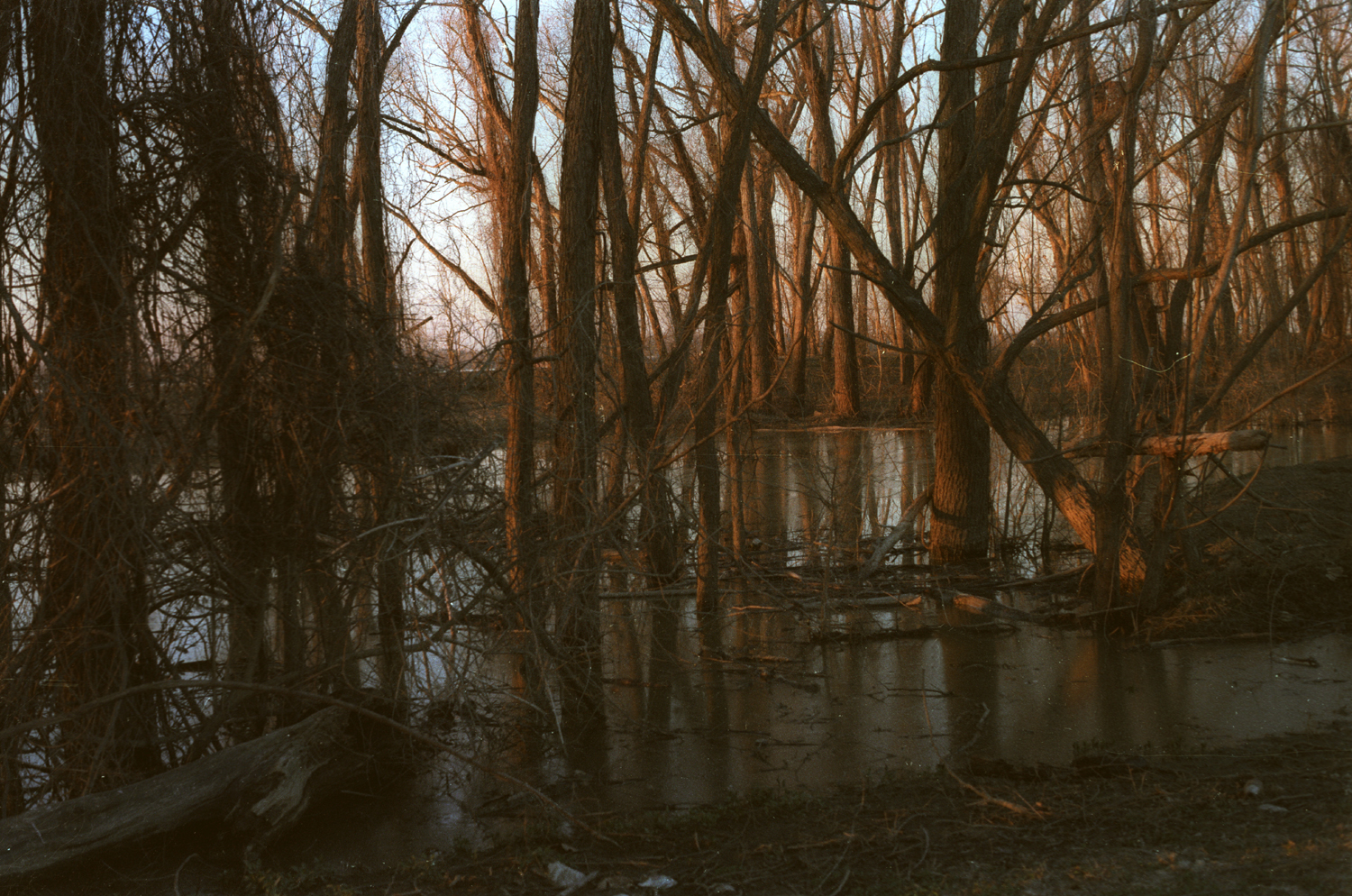
In 1982 I got the apartment, a couple of blocks north of campus, in Varsity Village, and there I met persons, in particular Wood Grigsby, who knew southern Louisiana intimately. He it was who took me in early Spring to the place just south of LSU where you could drive up onto the levee (where some LSU cattle were grazing) and go down to the flooded willows, the river being high at this time. It was late afternoon and the place looked like a calendar picture of a swamp.
The edge of the Mississippi where mushrooms can be found at this time of year


In the shipyard across from Lockport (so actually in Rita, LA)
Wood also recommended driving down Louisiana Hwy. 1, which goes straight down the west side of the river. I haven't yet located the pictures of notable houses, such as Madewood, photographed as we drove south. The ones posted here date from April of 1986. After meeting Wood's family and some neighbors, we crossed over the lock to a shipyard to practice 20th c. industrial-subject photography and not far from there to make my first attempt at photographing bayous.
On Bayou LaFourche, a real houseboat cabin, much better than the reconstruction of one in the Audubon Zoo


Actually, in 1986 at the zoo in New Orleans I saw a reconstruction of a Cajun houseboat on a bayou, which can't hold a candle to the one above. I had yet to see the film, Louisiana Story of 1947, where a real one is shown in use; I got a vhs casette of the film at the State Library downtown, but now, of course, I have a dvd of it. It may have been made by Standard Oil, but it is beautiful and so is the Virgil Thomson score. I might have seen it in Oakland when it was shown at major theaters nationally, and was advertised on the movie pages, but I didn't.
At the Audubon Zoo in New Orleans, complete with pond scum, a Cajun houseboat. As I recall, there are even neutrias. Still, it looks slightly Orlando, compared with the one I saw on Bayou LaFourche.

Finally, here is one of the February 1985 Kodachromes of the LSU campus. As soon as I have all these relatively early photos in the Picasa albums, I'll add the album names at the bottom here.
Two of the most mature crĆŖpe myrtle tree in their nude beauty in February of 1985.
I'll put some live oaks in the album, too.


For photos giving context for the above images, see the album:
http://picasaweb.google.com/slokind/TheVarsityVillagePeriod19821986#
Captions will be completed soon.


Sunday, May 23, 2010

Transition again: to secular life

Perhaps I shall find a way to write separately of the manifold experiences of of teaching the secondary-school pupils of St. Hilda's and St. Hugh's School in the five years or so between the novitiate and life profession in religion (for, in the event, it was decided that I was not to be life-professed), but teaching the adolescents and my engagement with it was practically unaffected by religious testing. Indeed, using my art-school training I was able to contribute not a little to the production of brochures and programs as well as, for example, helping the upper school to make attractive posters for annual productions and, in a pinch, making doves to be carried for the Presentation in the Temple in the Christmas Pageant, with their cage made from twigs gathered in Riverside Park. And I photographed some School athletics and gymnastics. Also, told to work out the schedules for the variable, elective courses for the upper school, a formidable juggling of teaching personnel and room use, I simply plunged in and did it, somehow, and it worked (at least as well as it usually did). A computer would have been useful, but, though we had a couple of them upstairs, at the time very little was done beyond teaching a few students BASIC. Only after I had left the Order did I see an Apple IIe, on which one could write text (but not WYSIWYG) or play Space Eggs in green on black. Mostly, however, I taught Latin (and once first-year Greek from Chase and Phillips) and Grade 9 History from William McNeiil's Ecumene, a most admirable textbook. I think it is still used in Canada, but it seems not to be in use in the USA now. In my last year, Teachers College sent me a student teacher; what TC thought of my methods I have wondered, but I enjoyed working with her.
I do not remember the date when my future was decided. From that time, though, I was allowed to go to the Avery Library at Columbia and to the Institute of Fine Arts of NYU, opposite the Metropolitan Museum, to do what I could to catch up on seven years out of my field of study. I applied for every position for which I was qualified in the College Art Association listings, but, considering that I had been an Associate Professor for six years at U. of Oregon, and that the economy was in much worse condition in 1981 than it had been in 1973, I considered quite seriously that my religion might be really and truly tested by utter poverty and the necessity of thinking of myself as lacking even the means to re-train for any kind of employment at all. I begged help of everyone I could think of, advice or recommendation. In the meantime, fearing that I might have a cancer, and seeing the Guttman Institute advertisements in the NY Subway, I asked permission to go there. The upshot was that biopsy confirmed that surgery was necessary, that, lobular, it was usually bilateral, that both were done, and that it was in time, since there has been no recurrence now in 29 years. Meantime, the one place in the USA that wanted someone beyond a new PhD, Louisiana (with Oil still doing well), had brought me to Baton Rouge, had given a freshman class the chance to be taught for one lecture by a fully habited Sister, and had offered me the position in ancient art, with the rank of Professor, with three-year tenure, to be made permanent (or else) after three years. They said nothing to me about the mastectomies when I told them of them, but one can imagine...
Let me say, what is obvious, that I owe my life to the Community, which had health insurance, to the excellent Dr. Payson at Beth Israel Hospital, to the Guttman Institute for its public offering of really good free diagnoses, to all who helped me get a position (and a more favorable one than I'd have dared hope for), and to the former friends from Eugene, Oregon, who just happened to be here when I applied, and finally to several new colleagues here, especially Prof. H. P. Bacot, who, among other things, arranged for me to live at the Faculty Club on campus for the first year. For my part, I taught for 25 years and took only one day of sick leave (laryngitis) and, so long as I might also teach my beloved Greek and Roman art courses, taught everything else that might be needed for which my broad experience at Oregon and the old, broad written exams for the PhD at Berkeley had prepared me. The University of California, my veritable alma mater, richly deserved a life's work for what had been made of me, and I can only hope that my life has been a justification for the existence of state universities "founded for the teaching of the Classics and of such other subjects as the Regents shall from time to time deem necessary." I think I have that nearly verbatim from UC Berkeley's Charter.
Last, among other friends, I would thank Yvonne, who visited in the hospital and brought me Gore Vidal's Creation to read, and let me stay with them, and sustained me beyond words.

Monday, May 17, 2010

Coincidence of the once disparate


Is it because one is old that new elements and others remembered from the past seem to coincide? Years ago, in the 1970s, Sister M.C., then novice mistress, handed me a lovely Thames and Hudson publication on The Tree of Life. On the cover, and again inside, was a 15th century full-page painting from a Ms, German or Swiss, I think, of Adam and Eve and the Serpent on the Tree in the Garden. I might meditate on it if I wished. It was no common image; everything in it, though nominally natural, was potently significant. Eve was certainly Mary and the Church. The Serpent was neither innocent nor ugly, and it had a feminine head (reminding me now of the Glykon serpent found at Tomis or the Agathos Daimon of Alexandria). But I can't remember all the details, nor can I find my notebook in which I wrote about it, and what I wrote then I might dislike now, if I considered it personally. Even then, however, I took Sister's lending it to me as a way into the devotional mentality that had sponsored and produced it. The text of the book was Jungian, and already I was in no mood to play Bill Moyers to Joseph Campbell, but the picture was theological, to the nth degree. I had associated this kind of thought with the continuum from Boethius through Aquinus and especially in the beautiful Latin of the Victorines, some of which I had read in the year before I entered the convent, and with Chartres.
I was surprised, therefore, to discover it intact and so intense in a 15th-century Ms.
Then yesterday my lifelong friend, N.S., sent me her completed paper on Josquin's Illibata Dei in its theological and political context, in the ecclesiastical conflicts of the century following the Council of Constance. It isn't published yet, so I can't cite it, but the same learned intensity that I had discovered in the Ms painting is fully and beautifully set forth in this paper. As I was taught (and everyone is taught by a certain faculty at a certain juncture of time and academic geography), the art of the middle ages was theological and that of the 15th century was preponderantly secular, the artists more formally concerned, and none of them much engaged, intellectually (except for Albrecht Dürer), with theological philosophy. Of course, that wasn't true, but perhaps my mentors permitted one's having that impression. And I do not recall from the Norton Introduction to the History of Music reading anything about the composers as scholarly propagandists, so to speak. I suppose I thought of them as resembling the popular accounts of the lives of Romantic composers.
Once again, as several times before in my life, history leapt to life, life as strenuous as today's news. One consequence was to set me to searching for at least a draft of my explication of that Adam and Eve picture. I didn't find it, but I found a stack of notebooks of meditations and the like from 1974 to 1981, which I had put away but not destroyed, some of them as tortuous in their struggle to think properly, to make myself believe what I wrote, as anything in Edmund Gosse's Father and Son. Yes, and that was why I had read Gosse so eagerly, for the earnest struggle and its dreadful effect on one's mentality. It wasn't as if anyone was asking me to be like the Plymouth Brethren, but that I was striving so hard to come to terms with a decision that I ought not to have made, that was made out of several kinds of cowardice in the face of life. Abandonment is not abnegation, whether abnegation is itself good or bad. And I can assure the author of the excellent blog whom my mentioning Sir Thomas Browne led to his leaving me a comment (and to my enjoying his blog immensely) that I had no idea that Gosse had written on Browne, and I can't imagine what his biography of Browne might be like.
But Browne, of course, brings us to further religious and political troubles, to the middle of the 17th century and to the everlasting question, whether a spiritual life implies any religious adherence, specifically adherence to a religion of the Book. Daoism, for instance, and even the heart of Buddhism are not theistic, and Lucretius and Plotinus, finally Boethius (naming only the most famous) are spiritual philosophers. So far as there being any contradiction between the intense spiritual content of Shostakovich's music and his professed atheism, I am inclined to think that the purest spirituality is often either atheistic or agnostic. Enthused spirituality, if I may name St. Teresa as such, is less intellectual and less pure, it seems to me. That of the mature Shostakovich, not to mention Beethoven in his late quartets or Brahms or Webern (choosing my favorites), is the real thing—or, should I say, the actual thing? Browne's Religio Medici reminds me, in a limited sense, of Bishop Gore of Oxford who quietly admitted, in a single sentence, that it was at such times as he could see the existence of a personal god that "all the rest followed". I'd cite the book literally if I had it at hand.
The crux of all this, from the first philosophers who tried to grapple with the interface of deity and reason through all the remarkable history of the forced marriage of sensory experience to mental experience, of the philosophy of the five senses to that of dreams and visions and glimpses of the beyond, is perhaps the essence of intellectual history. And aesthetics? Bremond's Prière et Poésie?

The picture book with the Adam and Eve was that by Roger Cook. The printings currently accessible of Cook's title have a different front cover and an inferior reproduction (pl. 44) of the Tree of Life / of the Knowledge of Good and Evil picture reproduced in it. It is, however, evidently the same: Berthold Furtmeyer, from the Missal of the Archbishop of Salzburg, AD 1481. Nearest to it iconographically is Hugo van der Goes's painting, which, however, is more straightforward (and it has the female headed serpent).
The basic study for Chartres is The Sculptural Programs of Chartres Cathedral by Adolf Katzenellenbogen.
Panofsky's Renaissance and Renascences and E. R. Curtius's European Literature and the Latin Middle Ages, inter alia, also influenced my thought.
There are of course also primary sources. And AbbƩ Bremond's essay, also in English, dated from 1918.

Thursday, May 13, 2010

Not another Novitiate memoir

Since the Episcopalian religious order that I entered in the summer of 1973 was of a traditional kind, with a traditional rule internally, suitably modified for our work in St. Hilda's and St. Hugh's School (Kindergarten through Grade 12), it was no different from others with a Rule of Augustinian type (viz, not Benedictine) and need not be described by me. It was traditional also in regarding its own life, like respectable family life, as private, and 30 years later I shall respect that privacy now as I did then. No one should imagine that anything curious or disreputable lurks behind privacy. Of course, the religious life as such seems exceptional. But nothing of its meaning is revealed by trying to lay it bare. I have said enough to show that I did not enter anything like a 1970s commune or like a New Age cult. The sisters were fully habited, and under the aegis of the Cathedral of St. John the Divine—at that time under Canon West. Since my years there, I know that the order has evolved, as religious orders often do, especially as regards their work, but I am no more privy to changes than other outsiders. Interested persons can find them by Googling. The school no longer includes an upper school, grades 9-12.
I can say that I learned how to read square-note musical notation (neums) and to sing the morning and evening offices (we read the midday offices alone during the school day) and wished that I had a good singing voice. I learned the church calendar and the offices particular to each season. I learned how to care for the appurtenances of the altar. For the requirement of spiritual reading I found classics that I loved, like FranƧois de Sales, and early 20th century Anglicans like Bishop Gore of Oxford, just to name two. Luckily, I was not so young that I did not know how to do housework and mending. It must have been hard for girls who had been raised in post-War houses and had never seen shoe polish.
Though I was assigned to the upper school and to teaching Latin and the Ancient-Medieval part of World History, we all, on a rotating schedule, were assigned to Kindergarten naps and to after-school play groups. Some of the Kindergartners didn't like naps any more than I had at their age. We had an enclosed roof deck for the play groups after school, and we sometimes took groups across Riverside Drive to the park when they could be closely enough watched. The after-school programs were needed, for parents who worked until 4:30 or 5:00 and had to get uptown on public transportation afterward. We had some children in the middle and upper school who had known one another since Junior Kindergarten at age 4 and some alumni who knew their classmates better probably than most of their cousins. Though in my time the school had as many as 800 pupils, most of the sisters knew most of them and loved them, difficulties and all. The religious rule forbidding partiality and private attachment was actually an advantage. Upper-school children who would not or could not study in a study hall period sometimes were sent to the kindergarten or the nursery (in which we had a few toddlers, but they had to be at least somewhat toilet trained) where they very happily joined in constructive play. Literally constructive: the school had splendid sets of large building blocks. From parents at Columbia University, we had abundant supplies of folding paper from computer printout; I quickly learned that little children loved considering colors in rainbow order or in the form of a color wheel. Magic. It was the quisenaire rods that correlated color with unit-length that inspired me to set kindergartners to using their crayolas to make repeating rainbow sequences produce predictable patterns. After school, of course, when it rained the play school had to be indoors, where, I can report, children really loved to be read to and to play singing games, some of which I had played in 1939-1940 and have seen very recently when I chanced to see a bit of "Barney". I think that Daniel Pennac is quite right that, to produce lifetime readers, it is important to read aloud to children stories that actually interest them and to do so throughout grade school. Simply because a child can cipher the words off the page does not ensure that he or she can grasp the phrases, can get the meaning of syntax, or do so effortlessly. It is pretty harsh to ask him to read for himself at that stage; it is not a pleasure; it is not yet really meaningful. Besides, if his family and teachers really loved him they would not quit reading to him, would they? Reading aloud to children is love. I remember Mrs. Cheda in Grade 2 and Mrs. Lyman and Miss Hamilton in Grades 4 and 5 reading aloud to us in the last period of the school day, almost every day. So far from discouraging our reading for ourselves, this reading was a reward at the end of a good day, and, speaking for myself, it sent me to the public library almost every Saturday. I remembered them when I was at St. Hilda's.
I do not know whether the Reverend Mother, the headmistress (and founder of the order), had any idea of the difference between teaching hippies in Oregon (or university undergraduates in any decade) and teaching middle- and upper-school adolescents within a stone's throw of Columbia University. Their popular culture wasn't so different: they all loved The Doors and the other groups, and I'm afraid that some of them knew more about street drugs than I did. Eventually we had a school bus for the younger children, but the adolescents used the public bus and subway, and they could mix with university students and with those who were attracted to the university students and even socialize in the jazz club and other cafes, especially if they could pass as undergraduates. Keeping street clothes in their lockers of course was practiced. It could not really be prevented. But a spaced-out private-school kid could not, in most cases, be discussed with his or her parents (and certainly not by a Sister), since, famously, the parents were certain that they and their children were completely open with one another. And the school, though not among the most expensive, did ineluctably depend on fees, only a few being on scholarships. So the 1970s culture was largely shared, though the setting was different, but as a secular I could sympathetically confront an undergraduate about drug use and as a religious sister and with adolescents still children I could only try to offer some silent security and assurance, unspoken, of care for them and to teach them as well as I could.
Most of my pupils, of course, were NOT into drink or drugs or even much sex (judging by antennas that though not infallible are not worthless in staying attuned to one's students). And, so far as parent conferences can be pleasant, their parents were mostly delightful persons. My first realization was their mental immaturity; I mean, the human brain does develop in tandem with the body, but in Grade 8 or 9 both are still just beginning to be capable of algebra or formal grammar, and the first sentence of de bello Gallico is formidable: Caesar shot his wad right there. My books were provided, and I learned positively to like Jenney's. It wasn't silly, like the New Chardenal, from which I'd learned French. But how to use it for Grade 8, ages 12-13? First, I asked the school to issue those mottled black-and-white cardboard covered composition books, one per student, and required them to copy into them everything we did on the chalk board (while forbidding writing or drawing anything else in them). This included the English-to-Latin sentences which, dividing the class alphabetically, had to be put on the chalk board, then corrected, politely and without a waste of time, and the corrections were added in color in the composition books. Ecce, they liked using color. I had the school give me a box of colored chalk, and the class got their own colored ballpoints or pencils (only, the main text had to be in black or blue-black). Every Friday I collected the composition books, checked them for neatness and accuracy, and graded them * or + or OK or - (the latter only rarely, but so was *). Fact was, I was given no time for grading homework (besides, they phoned each other or copied others' in homeroom), this not only took the place of my marking it but lay bare who was just copying someone else's bad handwriting—and, if they did, at least they wrote it correctly in the long run. Add to that, they could use the composition books to study for tests and quizzes, and the better their work, the more useful it was. Further, as they learned this routine and did it more and more efficiently, we had more time for other instruction, some of it participatory. Though Winnie-ille-Pu is not all that easy, Cur ursus clamat / cur adeo mel amat / Burr, burr, burr / quid est causae cur? was not insulting, after all, and even provided an idiom. Writing stories of their own had to wait a while but provided an incentive to confront the 3rd declension. That early efforts had to be ludicrous explained why poor Mr. Jenney made them say such inanities as the first chapters abound in. Since the diagramming of sentences (1) was no longer taught in Language Arts and (2) does not work for an inflected language, I began writing out the more difficult sentences and underlining the subject of the finite verb, double-underlining that verb, using arrows to show what adjectives agreed with (their gender, case, and number being wholly dependent), circling adverbs (not declined) with an arrow to the "verb, adjective, or other adverb" that they modified. At this early stage, the most useful was simply [bracketing] all the prepositional phrases, usually leaving a very obviously simple main clause.
This device began very simply, and the class and I decided how novelties, such as dependent clauses, should be treated. The part of the alphabet that had been spared putting their homework on the board in time had the privilege of using the colored chalk themselves to mark the hard sentences. By the time we got to Caesar himself, in Jenney II, they usually could "mark" sentences mentally, once that formidable first sentence had been conquered.
Of course, that wasn't all there was to teaching kids. I'd have quit doing it if it hadn't worked so well and helped to produce more than our fair share of Advanced Placement scores. Only, I really did want them to understand an inflected language, and I really did want to teach them, and I learned to be especially well disposed to 13-year-olds, as possessing some of the best qualities of both children and adults. One necessity is to do everything one can, in class, to level out the girls and the boys at an age when the girls are often taller. But, if you don't make them use the language lab, boys do just as well in language as in algebra. I mean, conjugations and declensions and their uses evolved, too; we didn't make them up, and they have their own interesting quirks, just as Darwinian genetic isolates have.

Wednesday, May 5, 2010

Crossing the Continent in a Small Car

I have crossed the continent, or most of it, several times. One trip was in my Yugo, with a student who had never seen a real ocean, in 1990, a round trip from Louisiana to Oregon mostly via I-10 and I-5. The others were alone. I may be too old to do it now, but I love being in the middle of nowhere, driving, alone. The first time was when I drove in a 1967 VW Beetle to NYC to become a postulant in the Community of the Holy Spirit in the summer of 1973, which I shall try to recount now. The second was when I drove a newly acquired 1975(?) VW Rabbit from Oregon to Louisiana. I had been cross-continent before, on Canadian Pacific across Canada to meet the Empress of England to cross the Atlantic and, in the opposite direction, on the train to Chicago to take the Union Pacific train to San Francisco, and also had flown in a DC 6, which was anything but non-stop, from Oregon to Chicago, whence a DC 3 took me to Urbana, Illinois, to be interviewed for a position. That short flight was wonderfully close to the ground, so one could see houses and even count cattle, a mercy since these WW II planes were not pressurized and later, when Olympic Airlines took us over real mountains in one, it made me quite sick. The essential thing before I make basic errors is to remember which route I took on which trip. What I do not remember I shall omit.
I remember stopping at what may have been a truck stop on the freeway at Reno. I had never been to Reno and did not go into town then. It did have lots of slot machines on the premises, which I had never seen in California, let alone Oregon. I mention this and other dull facts to show how very little I knew the USA. I mean, one knows the Grand Canyon but not the states it passes through, the reputation of Reno for divorces and gambling but not the place as such, New Orleans but only for Mardi Gras in Holiday magazine, the Carolinas but only, in the same magazine, for photos of belles in flounces posing at plantation homes. I remember driving across the Salt Lake desert and hoping, trusting, that nothing would go wrong, such as a flat tire. I remember very heavy wind and seeing a tornado on the horizon in Nebraska, which was (and remains) all I wanted to know of them, since the opening of The Wizard of Oz was indelibly in my memory. I can't remember live footage of a tornado in any March of Time or Movietone News, but, of course, my movie attendance had been rationed and I still had never owned a television set. On the other hand, the first time the skirt of a serious hurricane affected my part of Louisiana, until I actually experienced it, hurricanes too were something in Life magazine photos, silent and still. And dry! And no one had mentioned six days without fans or AC or lights in the heat of late August, even when you were about 70 miles up the Mississippi.
As I drove east on I-80 I began to remember where I'd first heard of the places I was driving through, in popular songs or in movies or in fiction. In Wyoming I thought of "My Friend Flicka" and its sequels, and saw that the light was different from what I'd imagined. Not imagined, exactly. But Hollywood films don't bother to go all the way to Wyoming for filming; one of the reasons for the industry's taking root in California, after all, is that it possesses reasonable facsimiles of so many landscapes. I saw an exit for a town called Green River for fuel and a late lunch. I remembered where I was going and why and stopped to go into a church, RC, in Green River. I understood the piety of votive candles but had never ventured to engage in it. For a child raised Presbyterian, they were in the category of holy water and genuflection, and maybe more so. But no one would know if I said a prayer and bought a candle in Green River, Wyoming. I only prayed that I might travel safely and left to deity whether it was right to leave a prayer behind me as I drove on. That night I stopped at a motel on the outskirts of Laramie. I chose motels for economy, and that one was typcial. Clean and safe. Period. But the next morning I drove through town, and, I must say, Laramie in 1973 looked as perfectly a western town as one could have imagined.
This was not a museum trip, or even an urban trip. That came later. A couple of decades ago I'd have been embarrassed to admit to the free associations that I made with only my own fancies as company as I made my way to New York City. By now I was following I-70, but I didn't go into Indianapolis. I stopped at an old motel, one with separate cabins, at a small town and thought of the only idea of Indiana I ever had had, from my grandfather's pleasure in the verse of James Whitcomb Riley and from some old movie in which someone sang "On the banks of the Wabash". It was not only that US geography had been taught no further than memorizing the names of all the state capitols; it was a state of mind induced by the idea of renouncing everything I'd identified with. I could not think of Greece, for example, without complex anguish, so I wasn't thinking of Athens or Berkeley or even Eugene. But this was no being stripped bare, only being reduced not to childishness, exactly, but to things simple enough for a child to deal with, perhaps. Here and now is the first time I've stopped to consider the fortnight I took between saying goodbye to my 87-year-old grandfather, beyond words or tears, because he cried, which I'd never seen before. In fact, in mundane terms, I really had burned all my bridges; I no longer had a way to support myself or savings sufficient to live for six months. I thought I had a vocation to religion, but it was entangled with nihilistic stuff, too.
I stopped for a night also in Zanesville, Ohio, which looked exactly as I had imagined. A town of dark red brick. It has remained my key idea of the midwest of America, though I might have chosen a more eminent city in Ohio. But I stopped there because, when I was in art school, the teacher of the course in creative writing that helped to keep the College of Arts and Crafts in Oakland fully accredited, and for Veterans, too, not only had introduced us to Dreigroschenoper but to Sherwood Anderson. I must admit that today I regard Sherwood Anderson with the greatest disapprobation one can have for an author, and that not for his politics but as a writer. Even then, I hadn't read him since the early 1950s but I wanted to get an idea of, literally, where he came from. Better I had taken the southern route through New Mexico and recalled To a God Unknown by Willa Cather! I stopped in Maryland at Frederick, for no other reason (though it was near sunset) than to stay where John Greenleaf Whittier had celebrated Barbara Frietchie: "Shoot if you must this old gray head, ...". In one of my last years in grade school, I had memorized it for recital in class. It is doggerel, which is always hard to forget. But, one more thing I didn't know about America at that time, I was on the wrong side of the tracks, racially. The African-Americans who ran the motel had no objection to my staying, but when I located an Episcopal church for Sunday service the next morning before leaving town and finding my Berkeley friend, M., by then in Fairfax County, the people at the church were visibly appalled by where I'd stayed.
I think it was while I stayed, for several days, I think, with M. and her family that on the occasion of a birthday party she sat the children around the dining room table, provided them with beans and embroidery floss and squares of felt and had them all, girls and boys together, making decorated beanbags to take home as favors, having first played a tossing game with them. It was on that occasion that I learned how to use chain stitch to fill in embroidered outline, a small skill that I put to use in the convent, when the annual bazaar was approaching and during Recreation we were doing every sort of salable handwork that we knew.
And so in a few days I drove into the parking area at the convent school. I am not sure whether my friends from Eugene, Sam and Betsy, were already at George School; if they were, I certainly stopped to see them, too. It is at Newtown, Pennsylvania. But I saw them once, too, at Leesburg, Virginia, where Betsy's family had lived, and it might have been in 1973 that I visited there. It is appalling that I recall so badly particulars concerning some of the finest and dearest persons I have known.
Indeed, having to write this post truthfully is the most difficult effort I have made so far in this blog.